
Everyone’s got a “human in the loop” for their AI content right now.
Sounds like a cute system. But a few years into this AI revolution, I think we all know what it looks like in practice:
Someone reads the AI draft. Maybe deletes a few em dashes. Goes “yeah, this feels fine.” Hits publish. Moves on to the next piece in the queue.
They call it editing. It’s actually just a VIBE CHECK.
And it’s how brands end up publishing more content than ever, while their standards slip with every draft, until 1 day they sound exactly like everyone else.
This happens because “vibe-checking” isn’t a real process.
So…let’s build a real one.
The 3 Symptoms of Brand Drift
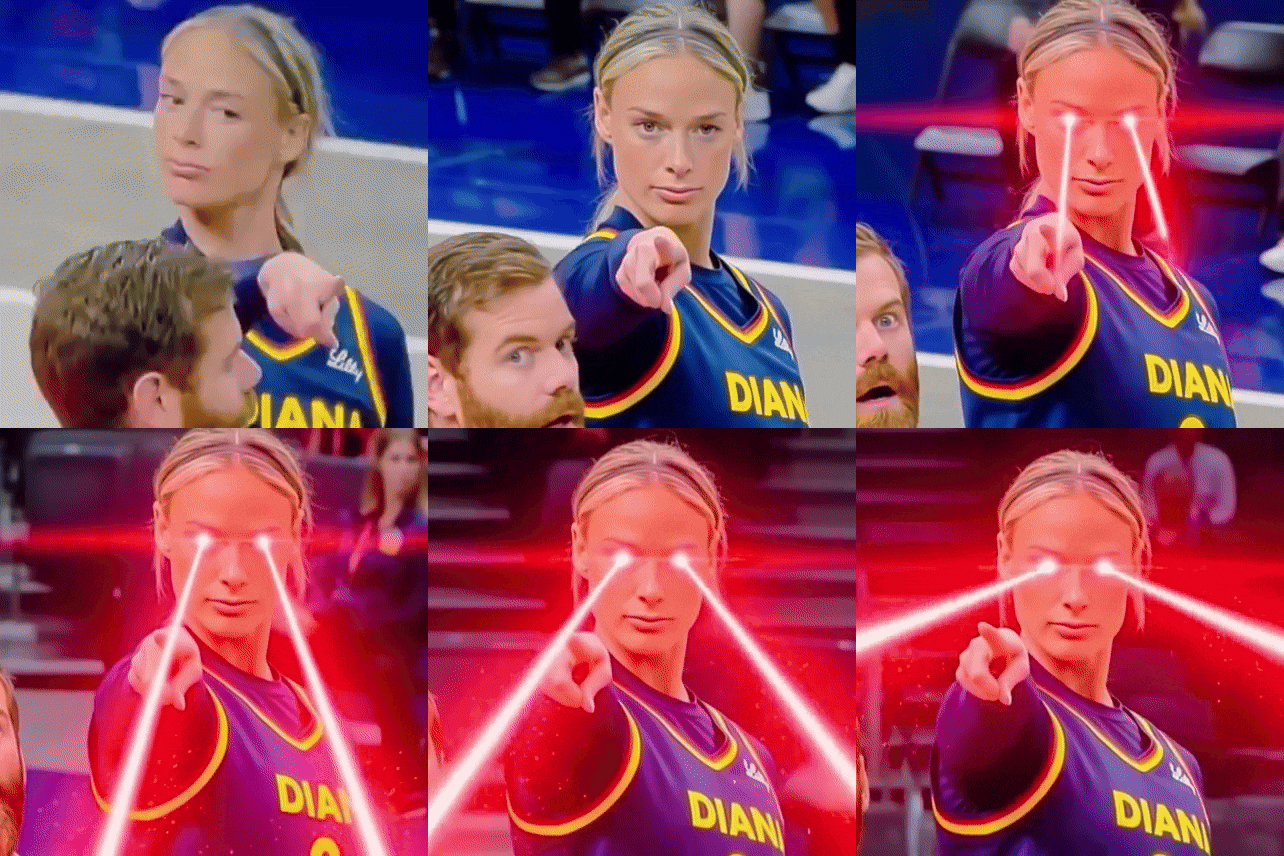
I’ve been calling this downhill slide BRAND DRIFT. 💨
It’s that sneaky, slow slippage of your standards. 1 AI draft at a time, you go from on-brand → “slightly off” → “generic slop.”

To fix brand drift, first you need to diagnose it.
Here’s what to look for:
1️⃣. Your voice is flattening. Your brand voice lives in a doc somewhere. But your AI doesn’t live in that doc. So all the spiky, specific, unmistakably-YOU stuff in your writing gets sanded down into something smoother, safer, and 10 times more forgettable. In the age of AI, “smooth” isn’t the goal. Smooth is just easy to scroll past.
2️⃣. Your opinions are disappearing. This is the sneaky one. AI doesn’t have a take. It has an AVERAGE of everyone else’s take. So the second you let it “come up with the angle,” you end up with a remix of stuff that’s already been said a 1000 times, mathematically-calculated to only have the APPEARANCE of a POV. In fact, there’s nothing worth arguing with, which also means nothing worth remembering. No matter how many times you put “hot take:” in front of it.
3️⃣. You’re drowning in a sea of sameness. Stack symptoms #1 and #2 on top of each other and then run them across an industry where everyone’s using the same 5 tools, and you get exactly what you’d expect: everything starting to look and sound like the same beige paragraph with the logo swapped out. If you’re not actively shoving your voice, your opinions, and your own data into the content, you quickly become just 1 more little drop in a beige OCEAN.
AI was trained on everything, so it sounds like everyone. Having an unexpected take with a real, current point of view is the only thing left that still works. But that ability is still a fundamentally human job! AI can’t really pull it off for you. It can only do it AROUND you. Badly.

“Okay, but if I’m optimizing for AEO/GEO, isn’t it what I HAVE to sound like?”
No. 🫶 And people who really live inside AEO and GEO all day will tell you the same thing.
Writing FOR robots just makes you sound like a robot. And for the record, robots want HUMAN writing.
Underline this part, plz: almost everything that gets your content pulled into an AI answer is the exact same stuff that’s made content good for HUMANS.
Since the dawn of the internet. Or the dawn of time.
Relevance, clarity, an actual point of view (sorry to keep hammering that), all the things that make a person willingly keep reading when they could be doing literally anything else.
Relevance does most of the heavy lifting here.
You can publish as MUCH as you want with a snap of your fingers now. But your audience still decides what’s relevant. Not you. Irrelevant content at scale is just a louder version of that same beige paragraph in that same beige ocean.

(Side note: a bunch of us retired the em dash from our ads this year. RIP. It used to signal “dramatic pause that sounds like human speech.” Now it signals “written by a robot,” so it had to go. Your intentions stay the same. How you execute them has to change. But I’m still mad about it.)
So if vibe-checking won’t save you from the sea of sameness…what will?
Glad you asked.
The Audit: How to Check Your Content (For Real)
Here’s the 6-point checklist I’d run on AI-assisted content before it goes anywhere near “publish.” Be honest!
1️⃣. Brand voice. Does this sound like you, or the smoothed-out average of “you”?
2️⃣. Audience resonance. Would your target reader get something out of this, or just scroll right past it?
3️⃣. AI citability. If an AI search engine yanked 1 sentence out of context, would it still hold up?
4️⃣. Factual accuracy. Is it citing real things, or confidently making stuff up? (It does this CONSTANTLY. AI once “researched” the completely wrong person for my own podcast. Thank god I double-check everything it hands me, because that would’ve been an awkward episode.)
5️⃣. Compliance. Does this clear legal and brand-safety bars? No, ChatGPT, Esq does not hold up in court, and no, you do NOT want to find that out the hard way.
6️⃣. Human distinctiveness. Is there a singular opinion in here, or is AI’s lukewarm take doing the talking?
You’ll notice grammar & spelling aren’t on here. Those are EASY compared to these 6. which is why a lot of teams aren’t asking and answering them before they hit publish.
And I already hear the objection: “Daniel, my team doesn’t have time to run 6 dense checks on every piece of content.” And that’s 100% fair. The teams doing this manually are working 3x, 4x, 5x harder for it, with 1 exhausted editor playing brand-voice police for the whole team.
That doesn’t scale. It just burns your best person out. Eventually, standards still slip.
Now we get to the real problem: how do you scale TASTE, not just volume?
Scaling the Thing That Lives in Your Head
Your brand voice mostly lives in 1 person’s head. Maybe it’s yours. Maybe it’s your best writer’s.
It’s a feeling. You know it when you see it. The thing that tells you immediately when something’s off.
In response, everyone’s go-to advice right now is “just build an AI skill for your brand voice.” Cool, that works great…for 1 writer, on their own laptop.
The second you try to scale that across a team, it starts to fall apart. Someone updates their version. The rest of the team has no idea. Now part of your content is being written off an outdated read of your own brand, and it’s flying under the “vibe-check” radar.
I’m sure this sounds familiar. It’s the exact gap Markup AI was built to close, and they’re not walking in with a brand-new idea pretending to be revolutionary.
Their platform is built on 20 years of enterprise experience doing the unglamorous, deterministic work of applying brand and style guides at scale, now rebuilt for the AI era. This isn’t a feature that showed up last year because AI got hot.
Instead of living in 1 person’s head (or inside a skill the rest of the team can’t see), Markup AI sits directly inside Google Docs and runs your content through agents checking everything on that audit list above: brand voice, audience resonance, AI citability, accuracy, compliance, human distinctiveness.
Issues show up as a clickable, one-step fix, right where you’re already writing. No new tab. No “hold on, let me go check the brand doc real quick.”
There’s also a persona feature I’m a little obsessed with. You can build out personas of your actual audience to review against. The 1 their product team built internally is, by their own admission, KIND OF A JERK. LOL.
I saw it for myself. He’s direct. Blunt. Zero sugar-coating. Which is exactly the feedback most content needs and never gets, because your coworker is too nice to tell you that paragraph doesn’t actually say anything. You know the 1.

There’s research on how bad this problem is, BTW.
Markup AI surveyed 135 Marketing and brand leaders, and:
- 92% said they’re using more AI for content than last year. BUT…
- Only 45% believe AI can reliably check its own output.
That gap (the 1 between how much is going out the door and how little anyone trusts it unchecked), is the whole point of today.
And duh, 96% of the Marketers surveyed said a tool that closes that gap would be valuable.
The demand is already there. It’s just a question of who sets up a system first.
The Takeaway: Long Live Editing
I’ve seen people say AI has killed editing. But I think it’s obvious now: AI just made skipping editing WAY more expensive.
Because now, there’s enough content going out the door that a quick skim is now a liability, not a strategy.
Vibe-checking isn’t editing. That takes a real audit, a checklist run consistently, that doesn’t depend on 1 exhausted human holding your whole brand voice in their head forever.
Markup AI’s browser extension for Google Docs is built for exactly this kind of audit, and it just went live.
As a reader of The Marketing Millennials, you get 60 DAYS free to try it. Most readers get 30. You’re not most readers. Not to brag.
I definitely recommend trying it out, just to see it in action inside your Google Docs.
Get 2 months of MarkUp AI free, right here.
Long live the editors.