
Ok, confession time.
I used to think UGC was simple. Find creator, get video, run ad. Easy, right?
WRONG.
I was basically throwing money at creators and getting back mediocre content that tested once and died. Then I’d start the whole nightmare again.
You know what I realized…I was treating UGC like a single piece of content when I should’ve been treating it like LEGO BLOCKS.
Let me break this down. Literally. 🧱
The UGC Purgatory
Scary story time:

You DM 50 creators. 5 respond. 2 actually follow through. You negotiate rates. Send the brief. Wait a week. They ask questions you already answered in the brief. You wait another week.
FINALLY they deliver. ONE video.
You test it. CPA is trash. Back to square 1, baby.
Find another creator. Do the whole dance again. Hopefully before someone asks “hey, where are those new creatives?”
It’s creative production purgatory.
An endless loop where you can’t produce enough content, or produce it fast enough, to test and find out what works.
Meanwhile, you’re spending half your life in creator DMs playing tag. “Hey, just following up!” (Translation: PLEASE DON’T GHOST ME.)
And when you DO get content delivered? It’s a coin toss. Sometimes it’s fire. Sometimes it looks like they filmed it in a gas station bathroom at 2am. (And not in a fun way.)
There’s gotta be a better way, right?
(Spoiler: There is.)
What The Hell Is Modular UGC Anyway?
Okay so here’s where my brain exploded.
Modular UGC is about getting PARTS, instead of 1 polished video.
Components. INGREDIENTS you can mix & match.
Think of it like meal prep (stay with me here):
You’re not ordering DoorDash every single night. You’re cooking a big batch of stuff on Sunday night and eating different combos all week.
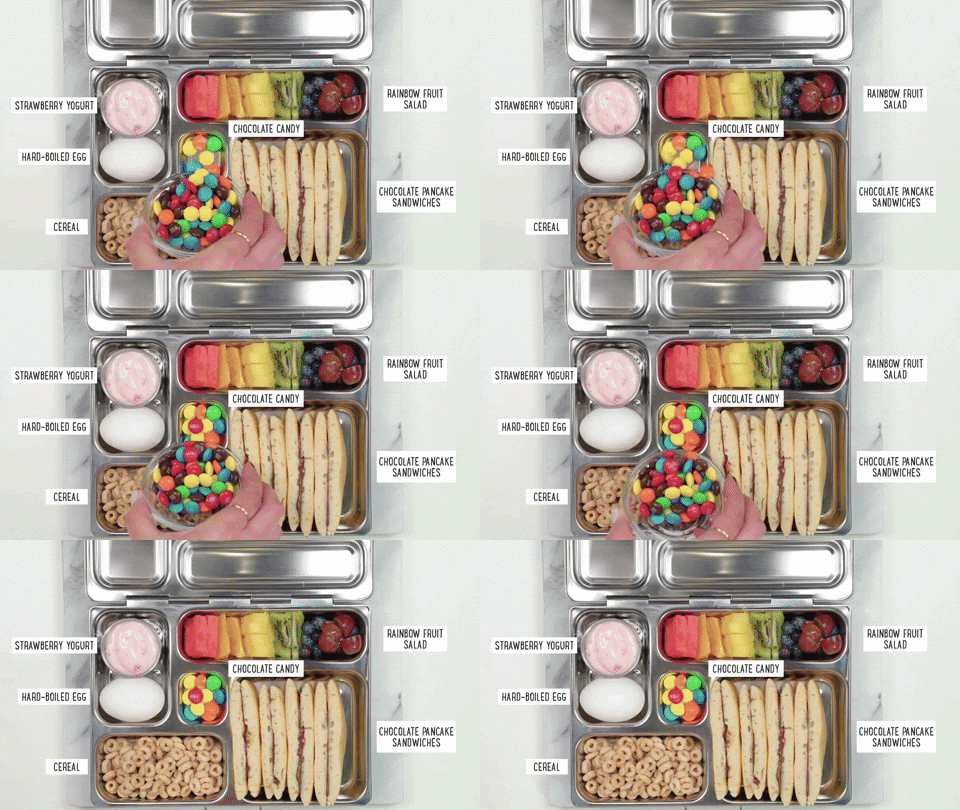
Modular UGC is the same concept. Each piece of the video = 1 ingredient for a final meal.
This way, the creator doesn’t film “a video.” They film:
- 5 different ways to start the video (hooks)
- Multiple product shots from different angles
- B-roll of them using it in real life
- A bunch of different endings (CTAs)
- Raw footage you can chop up however you want
Then YOU mix and match. Hook 1 + Demo 2 + CTA 3 = Video A. Hook 4 + Demo 1 + CTA 2 = Video B.
1 creator shoot = 20+ testable videos.
I know. WHAT.
It’s all about switching your mindset from a fixed recipe into a recipe TEMPLATE.
That’s the cheat code people are sleeping on.
Let’s Talk About The Money (Because Holy S**t)
The economics of this are INSANE. One example:
Old way: Pay $500 for 1 video. Test it. It flops. Pay another $500. Repeat until you cry.
New way: Pay ~$1000 for modular footage that becomes 20 videos.
Do the math. That’s $50 per video instead of $500.
(Sorry for making you do math.)
The point is, you can test SO MUCH FASTER.
Hook or CTA not hitting? Swap them out in a few minutes. INSTEAD of waiting for a new creator to film a whole new video.
Suddenly, you’re running ACTUAL rapid testing loops instead of just putting “rapid testing” in your strategy deck and hoping nobody asks questions.
This is how brands are pumping out so many creative variations per month without losing their minds and/or budgets.
How to Actually Pull This Off (Without Your Brain Melting)
A lot of people get excited about modular UGC, try it once, and then give up because it still feels chaotic.
I’m gonna save you from that. Here’s how to head off the chaos before it starts:
Step 1: Write Briefs That Don’t Suck
Your brief can’t be “make a cool video about our product lol.”
Generic garbage in, generic garbage out. 🚮
Instead, be SPECIFIC about what components you need:
“Record 5 hook variations, 3 product demo angles, 2 lifestyle sequences, and 4 different CTAs. Each component filmed separately. Deliver the raw files.”
Think of it like directing a photoshoot, not a TikTok. And the brief? That’s your shot list.

💗 Cheat code: use this Google Doc brief template for Modular UGC.
Step 2: Find Creators Who Get It
A lot of creators are used to making finished videos.
Ask for raw, modular footage, and they might look at you like you’re speaking Parseltongue.
You need creators TRAINED in modular production, who know they’re delivering raw materials.
This is where I started using Insense and honestly – it solves a huge headache.
Their creators are vetted specifically for this stuff. They understand modular briefs. They deliver the components you actually need. No more explaining the concept 47 times in DMs.
Step 3: Don’t Let Post-Production Kill You
Okay, now you have 50 video clips sitting in a Google Drive folder. Congrats! You’re overwhelmed! 🫶
If you don’t want to burn out, you need a SYSTEM.
Your options:
- Hire an editor ($$$, and they need to understand performance creative)
- DIY it in CapCut at 11pm on a Tuesday (speaking from experience, do not recommend)
- Use a platform with post-production built in (my choice for those who value their sanity)
Insense has an optional post-production service that takes your modular footage and creates the variations for you. You tell them “I want Hook A with Demo B and CTA C,” and they handle the editing.
💗 Cheat code: If you book a chat with Insense by Feb 27th, they’ll give you a $200 bonus.
Scale This Sucker Across Multiple Creators
Once you nail the process with 1 creator, you can multiply everything.
Run the same modular brief with 5 different creators. This will give you 5 different “vibes” to test.
Key word is DIFFERENT. New faces and environments. New angles. Diverse, authentic perspectives.
You need variety, because that’s how you test + learn something meaningful.
Some creators will naturally perform better with your audience. Some product angles will hit harder. You’re testing CREATOR + CONCEPT combinations instead of just “does this ad work?” and trying to guess why.
And here’s the sneaky smart part: while you’re building your modular UGC, you’re also building a footage LIBRARY.

Promoting a new offer? Pull clips from your library and pair with new CTAs.
Holiday sale? Remix existing footage with seasonal hooks.
Product update? Grab your best-performing clips and cut in new demo footage.
This system creates assets that compound, instead of expiring after 1 campaign.
A Brief Template to Screenshot Right Now
Okay, now I’m literally giving you the exact structure I use. Ready to copy, paste, and fill in the blanks.
YOUR MODULAR UGC BRIEF TEMPLATE:
HOOK SECTION (Film 5 variations, each 3-5 seconds)
- Pattern interrupt ➡️ “Wait, you’re still doing [old way]?”
- Problem callout ➡️ “If you struggle with [pain point]…”
- Benefit tease ➡️ “Here’s how I [achieved X result]…”
- Question hook ➡️ “Why does nobody talk about [thing]?”
- Trend/timely ➡️ “[Current thing] but make it [your product]”
PRODUCT DEMO SECTION (Film 3 angles, 10-15 seconds each)
- Extreme close-up of product details
- In-action demo (you actually using it)
- Before/after or comparison shot
LIFESTYLE B-ROLL (Film 2-3 sequences, 5-10 seconds each)
- Morning routine vibes
- Using product in natural environment
- “This is so easy” moment
CTA SECTION (Film 4 variations, 3-5 seconds each)
- Direct: “Get yours at [link]”
- Soft: “Check it out if you’re curious”
- Urgency: “Sale ends Friday, don’t sleep on this”
- Social proof: “Join 10K people who already switched”
TECH SPECS (Yell these at your creator):
- Vertical only (9:16 ratio, this isn’t 2019)
- Natural lighting (we’re not doing moody vampire content)
- Clean audio (no wind, no traffic, no screaming kids in background)
- Film each component SEPARATELY (this is key!)
💗 Level up: combine this template with the instructions in the brief sample I shared earlier.
Why You Need This Yesterday
There’s more than production + budget + sanity reasons to take a modular approach to assets.
There’s also the fact that Meta’s algorithm is a HUNGRY BEAST.
Feed it the same 3 ads for weeks, and your performance dies, CPMs go up, ROAS goes down, and your boss starts asking uncomfortable questions in Slack.
Fresh creative gives Meta Andromeda enough variety to test and learn what will perform for your brand.
Brands winning now are shipping new variations every week. Sometimes daily.
You can’t do all that with traditional UGC procurement. The math doesn’t math.
But with modular, you can take 1 ad that’s performing, and crank out 5 new remixes of it with your morning coffee.
That’s the game now. Creative velocity beats creative perfection.
A Before & After That Might Make You Mad
Let me paint you 2 pictures:
BEFORE MODULAR UGC:
- Budget: $5,000
- Creators hired: 12
- Videos delivered: 10 (2 ghosted you)
- Testing capacity: Basically none
- Time it takes to refresh creative: 4-6 weeks
- Your stress level: 11/10
- CPAs: Sad
- Your boss: “Where’s the new creative?”
AFTER MODULAR UGC:
- Budget: $5,000
- Creators hired: 5
- Videos created: 100+
- Testing capacity: MASSIVE
- Time to refresh creative: Whenever you want, today works
- Your stress level: Still high but for different reasons
- CPAs: Chef’s kiss
- Your boss: “Wow, how’d you do that?”
Same budget. 8x more creative output.
Way less time in creator DMs begging people to respond.
What You Should Do Right This Second
Buying 1-off UGC videos gets expensive fast.
Try modular. Even just ONCE to see how it feels. I even know someone who will give you 200 bucks for it.
Brief a creator for components instead of a finished video.
Mix and match.
Then, test like your job depends on it (because it kinda does).
You got this.
If you wanna skip the trial-and-error phase, and use a platform that’s already set up for exactly this workflow: check out Insense.
They have the vetted creators who actually understand modular production. Automated creator/influencer agreements and payments. A campaign management dashboard to manage product seeding, TikTok Ads, or Meta Partnership Ads, all in one place).
And a post-production service so you don’t need to become talent management, creative director, and video editor all in one. It’s basically the full stack for this exact playbook.
Book a free strategy call and tell them Daniel from TMM sent you. If you do it by Feb 27th, you’ll get $200 for your first campaign.
They’ll walk you through setting up your first modular campaign and show you exactly how to structure your briefs.
Before you know it, you’ll be stacking & remixing assets like a LEGO master.